
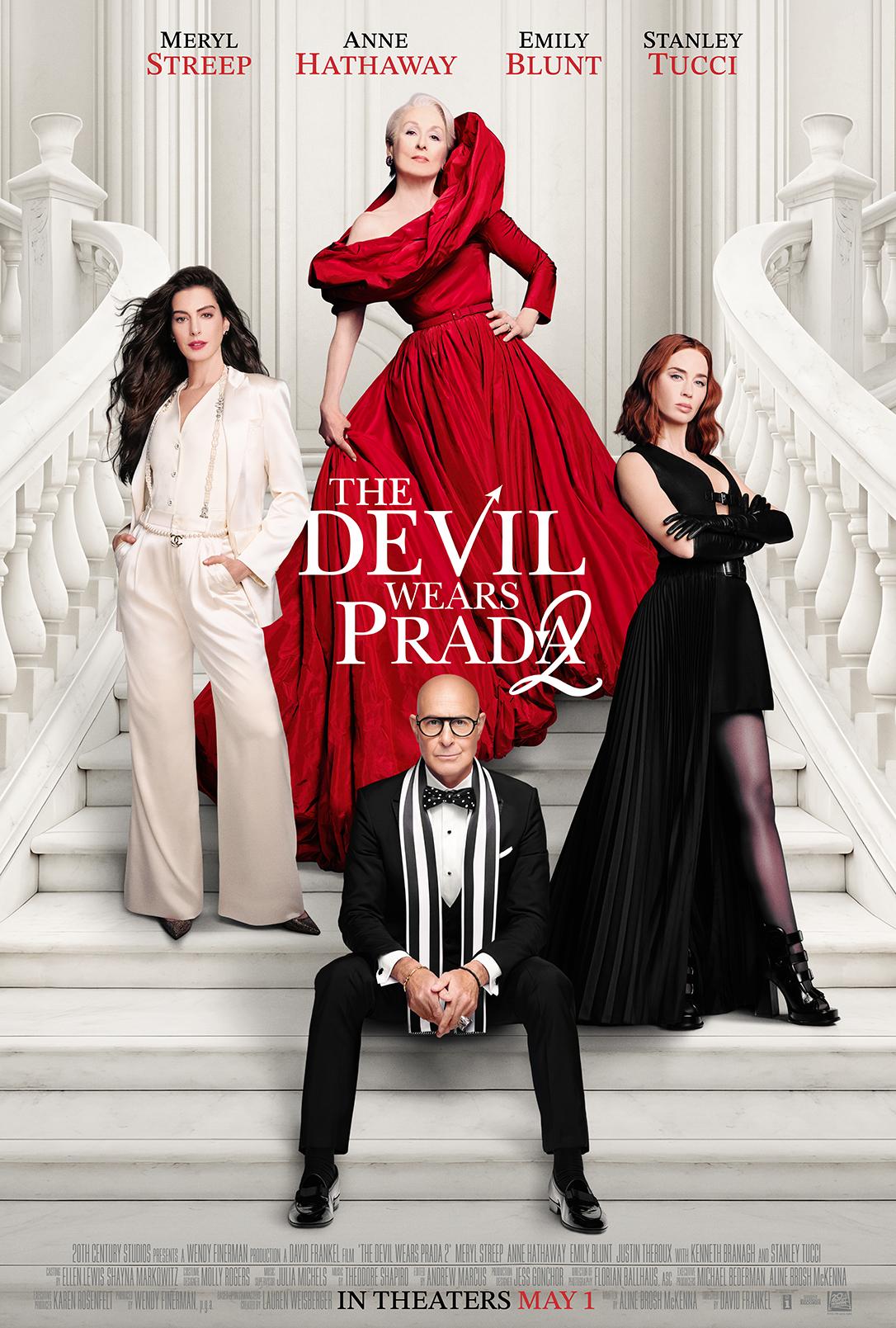
Rather than settling for legacy sequel slop, this ends up having its own touching substance to offer while we’re existing in this fast-moving and increasingly technological landscape of ours. To be frank, I was arching a major eyebrow at this movie when it was first announced, thinking it wasn’t all that necessary and it will only be around to prey on our desire for nostalgia. However, then its release date hit, at which point I started to hear audiences primarily go, “Hey, this is actually a decent time and has worthwhile commentary on its mind.” So this amped up my intrigue, and thankfully, the film itself has turned out to be a good one indeed. It slips us right back into the world that’s unfolded a couple decades after The Devil Wears Prada, feeling quite natural for us to reconnect with Andy Sachs, Miranda Priestly, Nigel Kipling, and Emily Charlton. There’s clearly been growth that they’ve embarked on over all of this time, but the essence of their character remains at the core of things, like when we’ve got Andy pursuing her work with a go-getter attitude that can be handy for her, even when it’s accompanied by that wide-eyed energy and it can rub others (such as Miranda) the wrong way. The stars themselves naturally fit in with their roles, too, and it’s pleasant to watch them return onscreen—Anne Hathaway with Andy’s eager and clever passion, Meryl Streep with Miranda’s Type-A precision and cool condescension (though it’s interesting to see how Miranda has to pull back just a little when it comes to being so overtly domineering in this modern era), Stanley Tucci with Nigel’s humble diligence and sharply quippy sense of humor, and Emily Blunt with Emily’s determination to climb up the ladder and snag what she believes her workaholic heart deserves.
All of this rolls out on a road that’s concerned with how quickly our world is changing and how we’re left to wrestle with these shifts if we want to keep progressing forward. Yes, evolution is inevitable, and sometimes, it can be understandable and even laudable. Look at something like how Miranda has to adjust her workplace behavior as a response to HR complaints, with her current assistant Amari (who’s played by Simone Ashley, and we most certainly need her showing up in far more movies) standing by to basically go, “Hey, let’s tweak that inappropriate language,” at multiple points. But while we have ultimately good changes like this, there are others that land in a place of undesirability, with generative AI being a big example. Our society is doing everything it can to shove this newfangled piece of tech in our faces, even as it’s damaging the environment, dulling our capacity for self-reliant intelligence, and stealing jobs that could be going to human workers. This makes it so goddamn refreshing to watch The Devil Wears Prada 2 push back against AI while supporting the artistic creativity that humans are capable of and the power of journalism. No, we don’t need some fool who’s chattering away about space exploration acting like fashion design can be handed over to the soulless entity of genAI. We don’t need to behave like this tech is a facet of our world that will absolutely come along no matter what we do. We can repel it if we’ve got enough willpower. Props to director David Frankel and screenwriter Aline Brosh McKenna (both of whom have returned from the first film) for capturing this perspective with the genuine spirit that it needs for this story to exist (even if it can come off as somewhat hypocritical for a big movie to be saying this when it’s being pumped out by the Hollywood industry and when it’s providing this position via the vehicle of the fashion industry, which is rife with its own exploitation). These are the roots that it requires for it to actually say something thought-provoking rather than leave me exiting it and thinking, “Well, that was a bunch of extraneous nostalgia-bait.” I don’t even think this spends a ton of time hammering its references into my skull. Sure, it drops in little Memberberries here and there, like when it gives those memorable stairs the spotlight (ohhhh, the stairs), but otherwise, it’s simply dedicating itself to telling a damn good story. Shout-out to the AI meme that shows up in the movie, because that was actually created by a human illustrator in real life, Alexis Franklin. Go check out the time-lapse video she posted to show off her creative process for this piece, because it truly is lovely to get this BTS look. Thank god this movie doesn’t resort to using genAI for the meme. See, it’s possible for humans to mimic the aesthetic! We simply need to work a bit harder to achieve the goal, and unfortunately, I think quite a few people are too lazy to go down that route and would rather fall back on clicking the genAI button.
As much as I like this sequel, though, I do wonder how necessary the romantic subplotting really is. I do think there’s some cute chemistry bouncing back and forth between Hathaway and Patrick Brammall, who plays Peter, Andy’s new love interest. But at the same time, if we were to cut their dynamic out of the narrative, I don’t believe it would affect things all that much. It’s not even like I loathe this part, because I don’t. I’m not left feeling like it majorly distracts from the time that, say, could have been spent on Andy and Emily’s bond. Relationships like that are able to have the room they need to breathe. But still, I wonder if an excision with Andy and Peter’s romance might have been all right. It’s intriguing to contrast that against the other relationships in the picture, since, for example, I find that Miranda’s marriage to her husband Stewart does a good job at rounding out the progression she’s made since 2006. It’s just plain nice to see her have a kind and down-to-earth partner that she can consistently depend on, because she does deserve that sort of love in her personal life (on a side note, I couldn’t help but look at Kenneth Branagh here in this loving role and think back on how convincingly he’d played a downright abusive husband in Tenet). I additionally think it’s suitable to depict the relationship between Emily and her new beau Benji in order to show how she’s gone down a different path and has fallen for someone who, to put it lightly, is a much more superficial type of person. Props to Justin Theroux for knowing how to humorously play this sort of prick, and in general, he’s got a knack for the asshole parts. Plus, it’s amusing to see him and Blunt star in this after he’d played her ex-husband a decade ago in The Girl on the Train.
There’s weight to The Devil Wears Prada 2 with its wit and its optimism that it didn’t have to muster up, but it did. It invested the extra effort. It rose above the basic level of quality that a different legacy sequel would have been perfectly content with. And I respect it for that. This is the sort of compelling foundation that more legacy sequels should build up for themselves. I daresay that I actually favor this sequel more than the first film, although I haven’t seen it in a few years. Perhaps I should revisit it sometime.
My final rating: 4 out of 5 stars

